(888) 632-8764
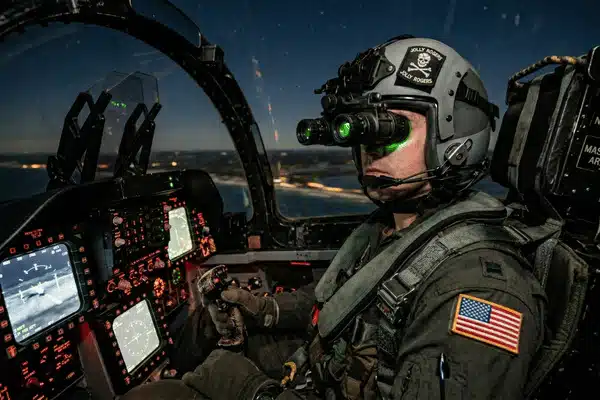
The night vision goggles used by US military forces have changed how warfighters operate after dark. From aviators flying at low altitude to infantry clearing a building, these systems make the unseen visible. Today’s military-grade NVG technology is more advanced than ever. Understanding it matters, whether you are a pilot, crew member, or safety officer.
Table of Contents
Current Night Vision Goggles Used by US Military Forces
The US military fields several NVG systems across all branches. Each is built for a specific mission role.
Aviator NVGs: AN/AVS-6 and AN/AVS-9
The AN/AVS-6 and AN/AVS-9 are the standard helmet-mounted night vision goggles for Army, Air Force, Navy, and Marine aviators. Both are Gen 3 binocular systems with a 40-degree field of view. They weigh around 550 grams and run on standard AA batteries. The ANVIS-9 is the newer model with better tube performance. Both flip up when pilots need full cockpit visibility.
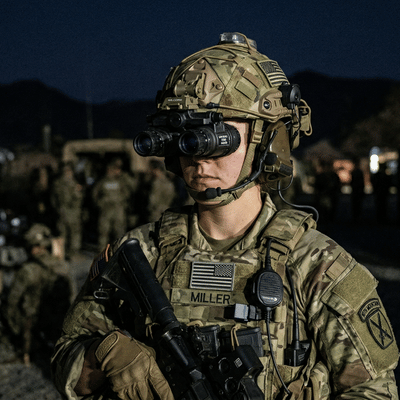
Ground Forces: PVS-14, PVS-31A, and BNVD-1531
Infantry and special operations troops use a range of military-grade NVG systems. Key models include:
- AN/PVS-14: A monocular used widely across all branches. Lightweight and versatile.
- AN/PVS-31A (BNVD): A dual-tube binocular with a Figure of Merit (FOM) over 2,300. Used by SOCOM.
- L3Harris BNVD-1531: Dual-tube goggle, 19 oz, with a built-in IR illuminator. Fielded to special operations.
Advanced Systems: ENVG-B and SBNVG
The AN/PSQ-42 (ENVG-B) is the Army’s most advanced fielded NVG. It fuses image intensification with thermal imaging into one binocular device. Over 18,000 units have been delivered as of 2025, according to Army PEO Soldier.
The Marine Corps uses the Squad Binocular NVG (SBNVG), a binocular system paired with a clip-on thermal module. Elbit Systems of America holds the contract, awarded in 2019.
How Gen 3 Night Vision White Phosphor Works
Most night vision goggles used by US military units today rely on Gen 3 night vision white phosphor image intensifier tubes. These tubes amplify available light, including starlight and moonlight, to produce a clear image.
Gen 3 night vision white phosphor tubes use a Gallium Arsenide (GaAs) photocathode. This delivers better low-light sensitivity than earlier generations. The white phosphor screen produces a black-and-white image instead of the classic green. Pilots often prefer it for better contrast and reduced eye strain.
Key tube specs to know:
- Overall tube performance is measured by the Figure of Merit (FOM). The best military tubes have more than 2,300 FOM.
- Auto-gating: Prevents flashes of intense light.
- Tube life: With the right maintenance, it usually lasts 10,000 hours.
Helmet-Mounted Night Vision Goggles: Fit and Integration
Helmet-mounted night vision goggles must balance weight, balance, and optical alignment. A poor fit causes neck fatigue and affects flight safety.
Aviation NVGs use an ANVIS or dovetail bracket to fasten to helmets such as the Gentex SPH-4, SPH-5, and HGU-56. For cockpit lighting to be compatible with the Night Vision Imaging System (NVIS), it must adhere to MIL-STD-3009. Noncompliant lighting reduces image quality and produces glare through the tubes.
With effect from 2015, FAA TSO-C164a mandates that all new aviation NVGs have matching tube chromaticity and be binocular. This reduces the risk of pilot fatigue and disorientation by ensuring that both eyes view images of equal quality.
Thermal Imaging and Fused NVG Systems
Modern military grade NVG systems increasingly combine image intensification with thermal imaging. Thermal sensors detect heat, not light. This lets operators spot people, vehicles, and engines even in total darkness or through smoke.
Fusion systems like the ENVG-B overlay both images so the operator sees heat signatures and fine detail at the same time. The system offers white-hot, black-hot, and outline display modes. Thermal clip-on modules used with the SBNVG give existing NVGs thermal capability without a full system replacement.
Standards, Certification, and Training
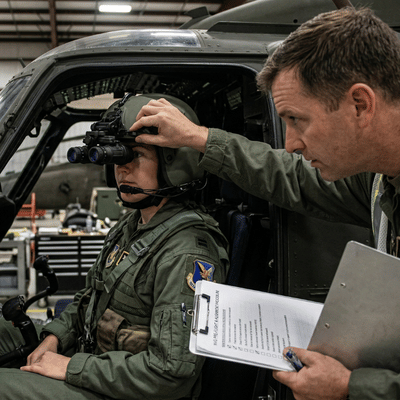
Using night vision goggles, as used by the US military, requires proper training. NVG flight is not simply putting on goggles and taking off. Pilots must complete FAA-approved NVG courses before any NVG operations. Training covers:
- Spatial disorientation and false horizon illusions
- NVG scan techniques and crew coordination
- Goggle adjustment, focus, and interpupillary distance (IPD) setting
- Emergency procedures with NVGs on and off
Regular recurrency training is required. Skills degrade without practice. Human factors, including depth perception limits and reduced peripheral vision, are a core part of every quality NVG program.
Ready to get NVG-qualified? Contact Night Flight Concepts to book your NVG training course today.
What night vision goggles does the US military use most?
The most widely used systems are the AN/AVS-9 for aviators and the AN/PVS-14 for infantry. Special operations units use high-performance binoculars like the AN/PVS-31A and BNVD-1531.
What is Gen 3 night vision white phosphor?
Gen 3 night vision white phosphor refers to third-generation image intensifier tubes that display a black-and-white image instead of green. Pilots prefer it because white phosphor provides better contrast and reduces eye strain on long missions.
Why are helmet mounted NVGs better than handheld devices?
Helmet-mounted night vision goggles keep both hands free for flight controls or weapons. They also maintain consistent optical alignment with the pilot’s eyes, which is critical for depth perception and situational awareness.
What is the lifespan of military NVG tubes?
The rating for Gen 3 image intensifier tubes is about 10,000 hours. Reaching or beyond that lifespan can be facilitated by proper handling, cleaning, and storage. Standard maintenance programs include tube inspections.
Does flying with NVGs require specialized training for civilian pilots?
Yes. Prior to any NVG activities, FAA-approved NVG flight instruction is necessary. The use of goggles, airspace regulations, physiological impacts, and emergency measures are all included in the courses. After initial qualifying, there are additional currency requirements.
What is the ENVG-B, and who uses it?
The ENVG-B (AN/PSQ-42) is a fused binocular NVG used by US Army and Marine Corps infantry. It combines image intensification with thermal imaging and can display AR overlays like maps and video feeds. Over 18,000 units were delivered as of 2025, per Army PEO Soldier.
The Bottom Line on Military Night Vision
The night vision goggles that the US military uses are some of the best optics in the world. Each system, from the reliable ANVIS-9 to the combined ENVG-B, lets you do more missions at night. But having the right gear isn’t enough. NVG operations are safe and effective when the people doing them have the right training, the right tools, and an understanding of how people work. If you fly rotary wing, fixed wing, or support ground operations, you need to stay up to date.
Get NVG-qualified with confidence. Book your NVG training course with Night Flight Concepts today.