(888) 632-8764
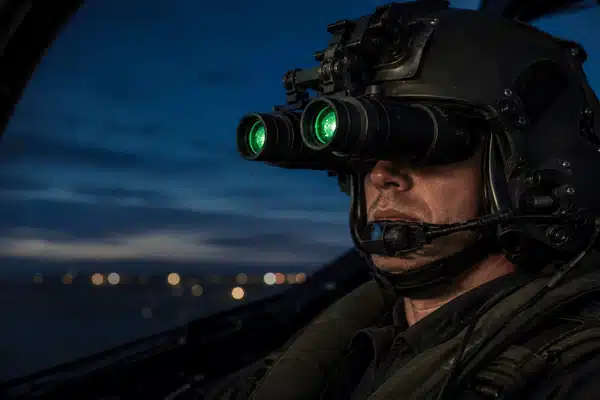
Helmet mounted night vision goggles have changed how pilots fly after dark. From military search-and-rescue to law enforcement, helmet mounted night vision goggles give aviators the ability to see terrain, obstacles, and hazards invisible to the naked eye. This guide covers the latest Gen-3 technology, required night vision training, key regulations, and what to look for when buying in 2026.
Table of Contents
What Are Helmet Mounted Night Vision Goggles?
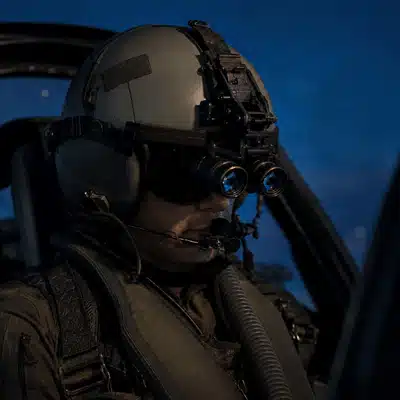
Helmet mounted night vision goggles are image-intensifying devices worn on flight helmets. They amplify available light, including infrared, to create a visible image in low or no-light conditions.
They are standard equipment in military aviation, EMS, search-and-rescue, and law enforcement. Gen-3 is the current benchmark for professional aviation use.
Gen-3 Technology: What Sets It Apart
Generation 3 NVGs use Gallium-Arsenide photocathode tubes with ion-barrier films. This gives them better sensitivity, clearer images, and longer tube life than older generations.
Two phosphor options are available. Green phosphor is the traditional choice and remains widely used. White phosphor night vision goggles are growing in popularity because they produce a black-and-white image many pilots find easier to read.
White phosphor night vision goggles offer better contrast in complex environments, especially when identifying shapes and surface textures. Many aviators now prefer white phosphor NVGs for their more natural, film-like look.
Night Vision Goggles Used by US Military
The night vision goggles used by US military aviators set the benchmark for the industry. Here are the most widely fielded systems:
| Model | Config | FOV | Notable Feature |
| AN/AVS-9 (ANVIS-9) | Binocular | ~40° | Standard military aviator NVG |
| L3Harris BNVD (AN/PVS-31A) | Binocular | ~80° | Low-profile, auto-gated, reduced head strain |
| GPNVG-18 (L3Harris) | 4-tube binocular | 97° | Panoramic FOV for special operations |
| ASU E3 PANO | Binocular | 94° | Lightest US-made NVG; ultra-wide FOV |
In April 2026, L3Harris won a $465M US Army contract to supply the NOVA binocular NVG under the BiNOD program. This confirms continued military investment in advanced helmet mounted night vision goggles.
Night Vision Training Requirements
The FAA requires formal night vision training before any pilot can use NVGs in operations. Rules are found in 14 CFR sections 61.195(k) and 91.205(h).
A complete program includes:
- Ground school covering NVG theory, limitations, and regulations
- Simulator exercises for emergency procedures and obstacle avoidance
- Supervised night flights (3 to 5 hours for initial qualification)
- Recurrent currency flights (1 to 2 hours) to stay current
Simulator-based night vision training is a great value. Pilots can safely practice wire avoidance, confined-area landings and engine failures at night before they ever encounter them. Research published in AirMed & Rescue (March 2026) showed that simulator training improves crew performance in high-risk NVG situations.
NVG equipment must be checked every 180 days to keep the goggles within FAA-accepted, certified performance standards.
Training Qualification Levels
- Initial Qualification: Ground school, sim exercises, and 3 to 5 hours of night flight
- Recurrent Currency: Refresher ground training and 1 to 2 hours of flight
- Instructor Certification: 6 to 10 hours as NVG instructor, plus practical evaluation
Ready to get qualified? Contact Night Flight Concepts for FAA-approved night vision training, NVG demos, and inspection services. Book your training today.
2026 Market Trends
The global military NVG market is growing rapidly. (GlobeNewswire, January 2026) According to ResearchAndMarkets, the market is expected to grow from $5.68 billion in 2025 to $9.88 billion in 2031, at a compound annual growth rate of 9.7%.
Key trends shaping the market:
- White phosphor replacing green phosphor in many fleets
- Thermal clip-on add-ons (such as the Theon IRIS-C) for enhanced detection
- Digital and augmented reality NVGs through the US Army’s IVAS program
- A EUR 100M European NVG order to Theon for deliveries through 2028
Supply chain pressures and export controls remain challenges. NATO interoperability standards (STANAG 1236) and large framework contracts are keeping competition strong.
Buying Guide: What to Look For
Choosing the right helmet mounted night vision goggles depends on your mission, aircraft, and budget.
Performance Specs
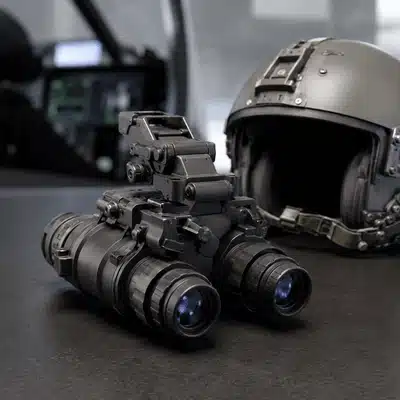
Choose goggles with high Figure-of-Merit (FOM) tubes for improved image quality, auto-gating for usage in brightly illuminated areas, and MIL-STD-3009 Class A NVIS compatibility for cockpit lighting. These features improve clarity, manage changing light situations, and promote safe use inside NVIS-compatible aircraft. They are especially critical for pilots and crews flying near cities, airfields, or under mixed lighting situations.
Ergonomic and Fit
Look for a system that weighs less than 1 kg, has adjustable eye relief and inter-pupillary distance, and offers counterweight alternatives. These characteristics serve to reduce neck strain, increase comfort, and keep the goggles properly oriented throughout long missions. A proper fit is essential for pilots and crew who must scan often while wearing a helmet.
Phosphor and FOV
Night vision goggles with white phosphor can provide better contrast in complex terrain and a standard 40-degree FOV works for most helicopter operations. Special operations that require wider visual coverage may be better suited to wide or panoramic FOV systems , typically ranging from 80 to 97 degrees . The right choice depends on the mission, terrain and the level of peripheral awareness required.
Procurement List
Before you buy, check the FAA certification status, do a cost comparison of long-term support and recertification, and ask about trade-up or PMA upgrade programs. Include packaged training and inspection packages to support correct use and maintenance. These details can affect compliance, readiness, and total cost of ownership.
What are helmet mounted night vision goggles used for in aviation?
Helmet mounted night vision goggles let pilots see terrain, obstacles, and other aircraft in low-light or no-light conditions. They are standard in military, EMS, law enforcement, and search-and-rescue operations.
What night vision training does the FAA require?
The FAA requires ground instruction, simulator exercises, and supervised night flights before a pilot can use NVGs operationally. Recurrent training is also required to maintain currency under 14 CFR 61.57(g).
What are white phosphor night vision goggles?
White phosphor night vision goggles produce a black-and-white image instead of the traditional green. Many pilots prefer them for their more natural look and improved contrast when reading terrain features.
What night vision goggles are used by US military pilots?
The most common night vision goggles used by US military pilots include the AN/AVS-9, the L3Harris BNVD (AN/PVS-31A), and the four-tube panoramic GPNVG-18. The NOVA binocular NVG is now being fielded under a 2026 Army contract.
How often do NVGs need to be inspected?
FAA-approved NVG inspections are required every 180 days. This guarantees that goggles will continue to meet performance standards and remain airworthy.
Can civilian helicopter pilots use night vision goggles?
Yes. Part 91 and Part 135 civilian pilots are authorized to operate with NVGs after receiving FAA-approved night vision training and meeting equipment requirements. The precise rules differ depending on the operation and the aircraft.
Helmet-mounted night vision goggles may improve safety, visibility, and mission readiness when used with certified equipment, adequate training, and routine inspections. Since 2006, Night Flight Concepts has provided FAA-approved training, inspection, repair, maintenance and lifecycle support for civil and defense operators of aviation NVGs. Their team also partners with law enforcement, EMS, commercial, utility, corporate and military aviation units throughout the United States, Canada and international markets.
Build a safer and more capable night operations program with an experienced aviation NVG partner. Request a quote from Night Flight Concepts today to discuss the right goggles, training, inspections, and support for your mission.