(888) 632-8764
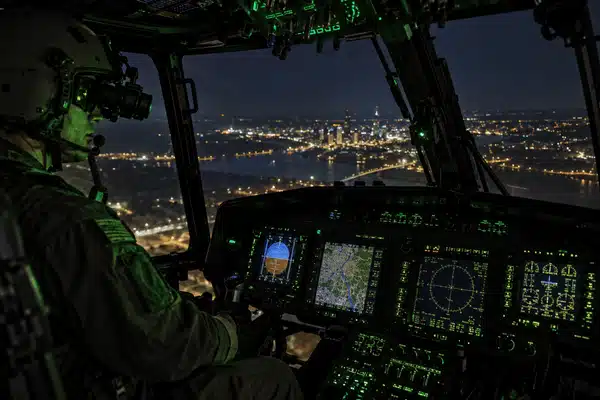
Night vision goggles can help pilots see more clearly after dark. But the goggles are only one part of the setup. NVIS lighting is what lets a pilot read the cockpit without ruining the view through the goggles.
NVIS lighting is widely used in certain civil rotorcraft sectors, particularly helicopter air ambulance and law-enforcement operations. In 2006, fewer than 5 percent of the United States helicopter air ambulance fleet flew with a night vision imaging system. By 2011, the figure was roughly 90 percent, according to the FAA Section 318 Night Vision Goggles Feasibility Study Aviation Rulemaking Committee report.
At Night Flight Concepts, we work with helicopter and fixed-wing crews that fly at night. We also help operators prepare aircraft for NVG use. This guide explains what NVIS lighting does and what usually goes into an NVG-compatible cockpit.
Table of Contents
- What Is NVIS Lighting and Why Does It Matter?
- Why Dimming Cockpit Lights Is Not Enough
- How to Make a Cockpit NVG-Compatible
- Key NVIS Standards You Should Know
- NVIS Lighting Trends to Watch
What Is NVIS Lighting and Why Does It Matter?
NVIS stands for Night Vision Imaging System. The term covers more than the goggles themselves.
An NVIS setup may include:
- Night vision goggles
- Cockpit lighting
- An NVIS display
- Filtered switches and warning lights
- Approved aircraft changes
- Crew training and maintenance
NVGs are designed to work in very low light. They can also react to light outside the range the human eye sees well.
This is made tangible by the numbers. The range of human vision is approximately 400–700 nm. The sensitivity of a third-generation image intensifier tube ranges from roughly 600 nm to just over 900 nm. On a moonless night, the majority of usable light actually lies in the deep red and near infrared spectrum, which the goggles gain instead of the blue and green end of the spectrum.
That matters inside the cockpit. A light that looks dim to the pilot may still interfere with the goggles. A warm white incandescent post light, for example, radiates a large share of its output above 700 nm. The pilot barely registers that energy. The tube amplifies it.
Glare, bright spots, or a weaker external image could be the outcome. This may make it more difficult to see aircraft, wires, terrain, or other dangers. The two effects to look out for, according to FAA evaluation language, are veiling glare, where scattered light lifts the entire scene and flattens contrast, and blooming, where a bright source washes out a portion of the image.
Good NVIS lighting keeps the panel readable without overpowering the goggles.
Why Dimming Cockpit Lights Is Not Enough
Turning the panel lights down is not the same as making them NVG-compatible.
Dimming lowers the amount of light. It does not fix a light source that gives off the wrong mix of wavelengths.
The governing standard reflects this. MIL-STD-3009 does not simply cap brightness. It caps NVIS radiance, which is the light output of a source weighted by how strongly a night vision tube responds to each wavelength. A source can be visually dim and still fail the radiance limit.
That is why some aircraft need an NVIS filter, a purpose-built light, or an NVIS-compatible LED.
The whole cockpit also matters. A single warning light, cabin lamp, or bright screen can affect NVG use.
So can light that was never meant to be seen at all. Light leaks around instrument bezels, glareshield reflections, illuminated circuit breaker panels, cabin dome lights bleeding forward, and a crew member’s own tablet or phone are all common sources of contamination.
Testing may include displays, switches, gauges, warning lights, and other sources. The goal is to make sure the cockpit works both with and without the goggles.
That second half is easy to underestimate. The same panel has to stay legible in direct sunlight, and NVIS filter material can shift the apparent color of instrument arcs and markings.
How to Make a Cockpit NVG-Compatible
NVIS modifications differ from one aircraft to another. Still, most projects involve the same basic steps.
- Examine the cockpit. Examine every warning indicator, display, switch, and light. The FAA compatibility checklist for rotorcraft covers flight and navigation displays, powerplant instruments, communication and navigation control heads, filtered flood lights, post lights, map and emergency lights, standby instruments such as the compass and standby attitude indicator, and aft or cabin compartment lighting.
- Identify trouble spots. Seek out sources that interfere with the goggles or produce glare. Evaluators look at the forward view, the cross-cockpit view from each pilot station, and the view through the side windows, because a source that is harmless from one seat can bloom badly from the other.
- Install parts that are compatible. This could involve LEDs, filters, or replacement screens.
- Change the brightness. Through the goggles, the panel must remain readable without getting too bright. The dimming range matters as much as the top end, since crews need to be able to bring the panel down far enough for very dark conditions without losing legibility.
- Test the entire configuration. During both regular and NVG use, inspect the cockpit.
- Finish the necessary approval tasks. Any modification to an aircraft must go through the correct approval process.
Some projects use a Supplemental Type Certificate, or STC, for certain aircraft changes. An NVIS lighting modification is generally treated as a major change, which means an STC rather than a field approval, and an STC is specific to a given make and model.
An STC can approve the modification itself. It does not automatically approve the operator for NVG flight.
Night Flight Concepts provides NVIS cockpit and aircraft modification support for military, government, commercial, and private operators.
Key NVIS Standards You Should Know
MIL-STD-3009 is one of the main technical standards used for NVIS-compatible aircraft lighting. Its full title is Department of Defense Interface Standard: Lighting, Aircraft, Night Vision Imaging System (NVIS) Compatible. It sets limits for things such as:
- Color
- Brightness
- NVIS radiance
- Display and indicator performance
Class A and Class B do not simply mean green versus red lighting.
| NVG Class | Basic Meaning |
| Class A | Uses a 625 nm minus-blue objective lens filter |
| Class B | Uses a 665 nm minus-blue objective lens filter |
The standard also defines several approved NVIS color ranges. These include green, yellow, white, and red for certain uses.
Class B systems can support some red indications that would not work well with Class A goggles.
This is why a simple colored film over a normal screen is not enough. The full light source must meet the needed limits.
NVIS Lighting Trends to Watch
Newer aircraft systems use more LEDs and electronic displays than older cockpits.
That can help with NVIS work because engineers have more control over brightness and light output. Some systems can also switch between normal daytime settings and NVIS modes. Dual-mode lighting of this kind removes one of the oldest compromises in the field, which was accepting a dimmer or color-shifted daytime panel in exchange for night compatibility.
White phosphor goggles are another shift. TSO-C164a permits achromatic white phosphor image presentation as well as the traditional monochromatic green. The cockpit lighting requirements do not change with the phosphor, because it is the class of the objective lens filter that determines which wavelengths reach the tube.
Aircraft makers are offering more NVG-compatible options, too. Robinson Helicopter Company, for example, received FAA approval for an NVG-compatible R66 Police cockpit configuration.
NVGs are also used in more types of missions today. Common examples include:
- Law enforcement
- EMS
- Firefighting
- Wildlife work
- Government missions
- Corporate and private flight operations
Cockpit changes still need careful review. Adding a new screen or light can affect an aircraft that was already set up for NVG use.
Can I just dim my cockpit lights instead of adding NVIS lighting?
No. Dimming lowers brightness, but it does not fix an incompatible light spectrum. The aircraft may need a filter, LED, display, or another approved lighting change. The full cockpit also needs to be checked.
Is NVIS lighting only used in helicopters?
No. Fixed-wing aircraft can use NVIS systems too. They are used for patrol, firefighting, surveillance, government work, and other night missions. The setup depends on the aircraft and its role.
What colors can NVIS lighting use?
MIL-STD-3009 allows several defined NVIS color ranges. These include green, yellow, white, and some red applications. The correct color depends on the NVG class and the part being used.
Does NVIS lighting replace NVG pilot training?
No. A compatible cockpit is only one part of safe NVG flight. Pilots still need the training and qualifications required for their operation. Recurrent training also helps crews stay current with night procedures.
What is an NVIS lighting STC?
An STC can approve certain changes to an aircraft’s approved design. Some NVIS lighting projects use this route. The STC approves the modification, but it does not automatically approve NVG flight operations.
Can any aircraft light be replaced with an NVIS-compatible LED?
No. The new light must work with the goggles and with the aircraft. Brightness, light output, location, and dimming range all matter. The change must also follow the proper maintenance and approval rules.
Making a cockpit NVG-compatible takes more than turning the lights down. The NVIS lighting, NVIS display, NVIS filter parts, LEDs, testing, and training all need to work together. If your aircraft needs NVIS modifications or your crew needs NVG training, contact Night Flight Concepts to book training or request a quote.