(888) 632-8764

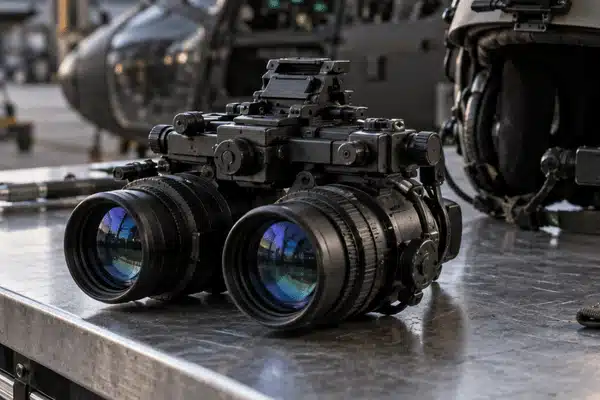
How much do night vision goggles cost for aviation in 2026? There’s no single price that fits every operator. The cost depends on the goggles, accessories, and services your operation needs, so the most accurate figure comes from a quote built around your aircraft, crew, and mission. The goggles you choose, the tubes inside them, and any extra parts will affect the bill. You’ll also need money for training, inspections, and aircraft lighting.
Here are the main costs to plan for:
- Goggles: Quoted by quantity, phosphor color (white or green), and configuration
- Mounts and accessories: Priced separately, depending on your helmet and configuration
- Inspections and repairs: Quoted by the number of NVGs and the work each one needs
- Inspection schedule: Every 180 days, per FAA guidance for Part 91 and Part 135 operators
- Pilot training: Quoted by course, number of students, and training location
- Aircraft lighting: Must be FAA-approved for NVG use, and lighting changes require a supplemental type certificate (STC)
Buying goggles is only one part of the process. Before spending anything, make sure the equipment meets FAA rules and works with your aircraft.
Table of Contents
How Much Do Night Vision Goggles Cost in 2026?
The aviation night vision goggles price depends on what you’re buying and how you’ll use them. Goggles made for ground use may cost less, but that doesn’t make them suitable for flying.
Here’s what goes into a quote from Night Flight Concepts.
| Equipment or Service | How It’s Quoted |
| Aviation night vision goggles | By quantity, phosphor color, and intended use |
| Helmet mounts and accessories | Depends on configuration; priced in addition to the goggles |
| NVG inspection and repair services | By the number of NVGs and the work needed |
| NVG training (initial, recurrent, instructor, or maintenance) | By course, number of students, and training location |
| Taxes, shipping, and international fees | Not included in quotes |
Source: Night Flight Concepts’ quote request form. Taxes, shipping, and certain accessories are not included. Additional fees may apply to international orders, and government agencies may qualify for a discount on inspection and repair services. Customers cover return shipping on goggles sent in for inspection or repair. An official quote follows a free consultation with a Night Flight Concepts specialist.
When comparing quotes, check exactly what’s included. Two goggles that look nearly identical may have different tubes, performance ratings, or approval status.
Public bid records show how much packaging can vary. When Fort Bend County, Texas, bought helicopter night vision equipment through a competitive bid in 2019, the winning bid, from Night Flight Concepts, included the low-profile battery pack with each goggle. The other bidder listed the battery pack as a separate charge. Comparing line items, not just the total, gives you a clearer picture.
What Affects the Price of Aviation Night Vision Goggles?
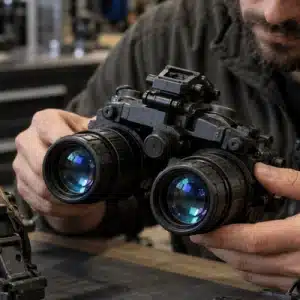
There’s more to NVG cost than the brand or model. A few details make a big difference.
- Image tubes: Gen 3 tubes perform well in low light. Tube quality plays a major role in pricing. Gen 3 tubes use a gallium arsenide photocathode. Aviation goggles such as the F4949 (AN/AVS-9) use auto-gated Gen 3 Pinnacle tubes.
- Number of tubes: Dual-tube goggles use two image intensifiers instead of one, increasing equipment costs. Some panoramic designs use four tubes to widen the view.
- Image color: Some pilots prefer the familiar green display, while others like white phosphor. Neither comes at one fixed price. Green phosphor is known as P43 and white phosphor as P45.
- Image quality: A clear image matters when you’re flying at night. Resolution, signal-to-noise ratio, and halo all play a part.
- FAA requirements: Goggles intended for flight must meet applicable approval and equipment requirements.
You may also see a figure of merit, or FOM, listed in product specifications. It combines image resolution and signal-to-noise ratio into one number.
It’s calculated by multiplying a tube’s signal-to-noise ratio (SNR) by its resolution in line pairs per millimeter (lp/mm). For example, a tube with an SNR of 30 and a resolution of 64 lp/mm has an FOM of 1,920.
A higher FOM can mean better image performance, but it’s not the only factor worth checking. By definition, FOM doesn’t account for halo size or phosphor color.
Night Flight Concepts offers Gen 3 aviation night vision goggles for professional aviation use. Our F4949 (AN/AVS-9) goggles are FAA TSO-C164a and EASA approved, comply with DO-275, and come in green or white phosphor. Standard accessories include a soft carrying case, lens caps, an operator kit, and a low-profile battery pack.
How Much Do Military Night Vision Goggles Cost?
Military goggles don’t all fall into the same price bracket. Some use standard dual tubes, while others offer panoramic views or combine night vision with thermal imaging.
The military night vision goggles price also depends on how the equipment is sold. Government purchases may include spare parts, support, and other services.
For example, a U.S. Army production order announced in October 2022 covered Enhanced Night Vision Goggle-Binocular (ENVG-B) systems along with spare parts, logistics support, and test equipment. Because contracts like this bundle so much, the contract value doesn’t translate into a simple per-goggle price.
Civilian buyers should know that military-grade equipment isn’t automatically approved for flight. U.S. export controls may also restrict where certain systems can be shipped.
For aviation operators, the better question is whether a goggle meets the needs of the aircraft and mission.
Where Are Aviation NVGs Used?
Flying after dark brings its own set of problems. Depending on the job, crews may need to find a landing spot, check the ground below, or keep track of nearby terrain.
Here’s how NVGs help on different flights:
- Air ambulance flights: Pilots use NVGs to assess dark landing zones and nearby terrain.
- Search and rescue: A crew searching a remote hillside can use NVGs to scan the ground without relying solely on searchlights.
- Police aviation: During night patrols, helicopter crews can watch poorly lit areas while keeping an eye on their surroundings.
- Firefighting: On approved night missions, pilots use NVGs to judge the terrain near the fire area.
- Utility work: Pilots use NVGs during certain flights near remote work sites.
How NVGs Support Aviation Missions
Assess dark landing zones and terrain.
Scan remote terrain in low light.
Observe poorly lit areas during patrols.
Assess terrain on approved night missions.
View terrain near remote work sites.
Of course, goggles don’t make every hazard visible. Power lines, for example, can still be extremely hard to spot.
Some lights can be a blind spot, too. In a 2009 safety alert, the FAA warned that certain red LED lights fall outside the range NVGs can detect, roughly 665 to 930 nanometers, so they may not show up in the goggles. The FAA has since added infrared specifications for LED obstruction lights, but older fixtures may still be in service. The FAA also notes that NVGs affect depth perception, limit peripheral vision, and are not designed to see through clouds.
Crews must continue using proper flight planning, training, and other safety procedures.
What Other Costs Should You Expect?
The initial purchase is just one part of the budget. You’ll also have to pay for equipment upkeep and crew qualifications.
Here are the main expenses to plan for:
- Mounts and batteries: Ask whether the quoted price includes the parts needed to wear and power the goggles.
- Aircraft lighting: Your cockpit lighting must be approved for NVG use. Check this before ordering goggles, since lighting changes can be costly.
- Inspections: Many operators have their NVGs checked every 180 days. Your equipment’s maintenance requirements will determine the schedule you need to follow.
- Pilot training: Pilots generally need ground lessons, flight training, and instructor endorsements under 14 CFR 61.31(k).
- Currency and proficiency: Training isn’t a one-time task. Pilots also need to meet the applicable NVG experience or proficiency-check rules in 14 CFR 61.57.
- Repairs: Tubes wear with use, and other parts can get damaged. Set aside funds for repairs rather than waiting until something fails.
These expenses can add up, particularly if you’re equipping several pilots.
Before buying, ask for a full quote covering the goggles, required accessories, and ongoing support.
What’s Changing in Aviation Night Vision Technology?
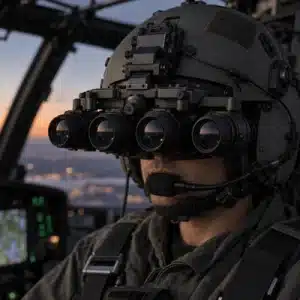
Pilots now have more choices than the familiar dual-tube goggles. Wider views and different image displays are getting more attention, though not every new design is ready for every aircraft.
In August 2026, Aviation Specialties Unlimited announced FAA TSO-C164a authorization for its E3 PANO night vision goggles. The manufacturer’s current specifications list a 97-degree panoramic field of view, with a tolerance of ±2 degrees. Separate aircraft and operational approvals remain necessary.
For comparison, standard AN/AVS-9 goggles such as the F4949 offer a 40-degree field of view. That’s an important development for wider-view NVGs. It doesn’t remove the need for the proper aircraft and operating approvals.
White phosphor is another option worth considering. It produces a grayscale image rather than the familiar green display. Both types remain available for aviation use. Night Flight Concepts offers AN/AVS-9 goggles with either P45 white or P43 green phosphor tubes.
Some military systems also combine thermal imaging with traditional night vision. The U.S. Army’s ENVG-B, for example, fuses white phosphor image intensification with thermal imaging. These systems have different approval requirements and aren’t common in civil aviation.
For most operators, a newer design isn’t automatically the better purchase. What matters is how well the goggles work for your flights.
How much do night vision goggles cost for pilots?
Night Flight Concepts lists an estimated price of $13,900 per aviation NVG. The final amount depends on the equipment and accessories included. Request a detailed quote to see what your setup will cost.
What is the full night vision goggles price range?
There’s no single price range that covers every type of goggle. A unit sold for ground use might be cheaper, while a panoramic or thermal-fusion system may cost much more. For flying, check the approval status before comparing prices.
Why are aviation night vision goggles expensive?
Gen 3 image tubes are costly to produce and test. Equipment used in aviation must also meet applicable performance and approval standards. Those requirements, along with servicing and support, affect the price.
Can I fly with cheaper night vision goggles?
Only if the goggles meet the approval requirements for your flight operation. FAA rule 14 CFR 91.205(h) addresses approved NVGs, aircraft lighting, and other required equipment. Goggles sold for recreational or ground use shouldn’t be treated as flight-approved.
How often should aviation NVGs be inspected?
Many aviation NVG programs follow a 180-day inspection schedule. The exact requirements depend on the equipment and approved maintenance procedures. Regular checks help identify problems with image quality and other components.
Can civilians buy military night vision goggles?
Many night vision devices are available to civilian buyers in the United States. However, some military equipment is restricted or sold mainly through government contracts. Export rules may also apply if you plan to send the goggles overseas.
How long do Gen 3 aviation night vision goggles last?
Gen 3 image tubes can provide thousands of hours of use. Some manufacturers use 10,000 hours as a performance test benchmark, but that’s not a guaranteed service life. Inspections and proper care help determine when parts need attention.
Buying aviation NVGs is a serious investment, so it’s worth getting the details right from the start. Look beyond the price tag and consider your aircraft, crew, and maintenance needs. Night Flight Concepts supplies aviation goggles and offers NVG training, inspections, and repair services. Get a quote to find out what your setup will cost and what you’ll need before your next night flight.