(888) 632-8764
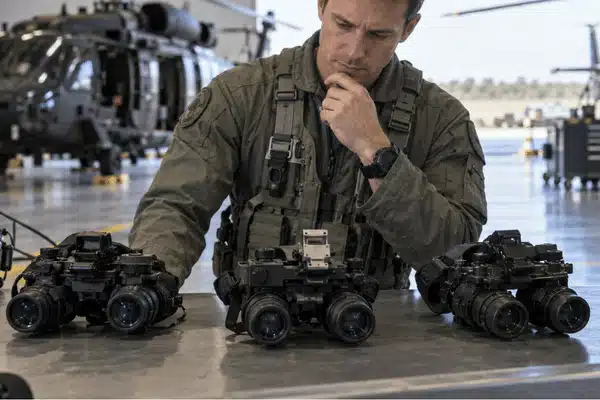
Picking the right aviation goggle is not just about choosing the newest model. ANVIS 10, ANVIS 9, and ANVIS 6 were built for different uses, and each has its own strengths. ANVIS 6 and ANVIS 9 use a two-tube binocular setup. ANVIS 10 uses four tubes to give pilots a much wider view.
Before buying Gen 3 aviation night vision goggles, it is also important to check your aircraft lighting, mission needs, training, and FAA requirements.
Table of Contents
ANVIS 10, ANVIS 9, and ANVIS 6: Main Differences
The clearest difference is the field of view.
ANVIS 6 and ANVIS 9 both use two image tubes and provide about a 40-degree view.
Manufacturer data for the AN/AVS-9 lists a 40-degree circular field of view at one power magnification, focus from 41 cm to infinity, interpupillary adjustment from 51 to 72 mm, and a binocular assembly weight of about 550 g running roughly 50 hours on two AA batteries.
ANVIS 10 uses four smaller tubes and gives the pilot a much wider image.
U.S. Air Force material lists panoramic aviation goggles at about 95 degrees of horizontal view. That extra side vision can help during low-level flying, formation work, and missions where crews need to watch more of the area around the aircraft.
| Feature | ANVIS 6 | ANVIS 9 | ANVIS 10 |
| Design | Binocular | Binocular | Panoramic |
| Field of view | About 40° | About 40° | About 95° |
| Tube layout | Two tubes | Two tubes | Four smaller tubes |
| Main use | Aviation | Aviation | Military aviation |
| Aircraft type | Fixed and rotary-wing | Fixed and rotary-wing | Specialized military use |
The model name is only part of the picture. Tube age, gain, resolution, phosphor, optics, and overall condition all affect what the pilot actually sees.
ANVIS 6 vs ANVIS 9
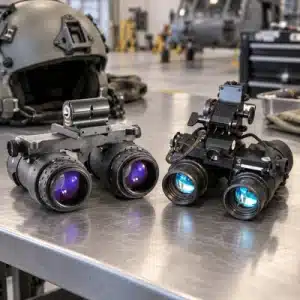
The ANVIS 6 vs ANVIS 9 comparison is sometimes described as helicopters versus airplanes. That is too simple.
The AN/AVS-6 was originally developed as a lightweight third-generation system for helicopter pilots, built around an 18 mm MX-10160 or MX-10160A tube, designed to let crews recognize terrain obstacles at 200 feet and below at speeds up to 150 knots, and mounted to the SPH-4 helmet. The (V)3 version added gated power supplies to the tube.
Both systems are used in fixed-wing and rotary-wing aircraft. Current versions can also use gated Gen 3 tubes, including green and white phosphor options.
ANVIS 9 has very broad use. Elbit Systems of America says its F4949 AN/AVS-9 is used in more than 60 countries. It is also listed as a standard night-flying system for the U.S. Air Force and Navy.
That does not mean every ANVIS 9 will perform better than every ANVIS 6.
The better comparison is between the actual goggles in front of you. Check the tubes, optics, mount, power supply, age, and service history. A well-maintained ANVIS 6 with newer tubes may give a better image than an older ANVIS 9.
ANVIS 10 vs GPNVG 18
The ANVIS 10 vs GPNVG 18 comparison comes up because both use four tubes and provide panoramic vision. They are still designed for different jobs.
ANVIS 10 was developed for military aviation. Its wider view helps aircrew see more without turning their heads as often.
The GPNVG-18 is a ground system. L3Harris calls it a Ground Panoramic Night Vision Goggle and lists a field of view of about 97 degrees. It uses four 18 mm image tubes.
The published specification is 97 degrees plus or minus 2 horizontal by 40 degrees plus or minus 2 vertical, a weight under 800 g without accessories, and about 14 hours of run time at 25°C on four DL123 batteries.
A US Army and NASA flight evaluation comparing the AVS-9 against a panoramic goggle is a useful reality check on wide field of view. The panoramic unit tested provided a 100-degree horizontal field made up of a 30-degree binocular center section with a 35-degree monocular section on each side. Measured resolution through the device was lower than the AVS-9 at every tube position, and the outer peripheral tubes were the weakest of the four. Three of the four pilots flew landing and bob-up maneuvers better with the panoramic goggle, while all four flew the pirouette better with the AVS-9.
The evaluation concluded that the benefit of the expanded field of view was to some extent negated by the reduced image quality.
So while the two systems share a similar idea, they are not direct replacements for each other.
A pilot should not choose a goggle only because it has a wider field of view. Aircraft approval, cockpit lighting, mounting, weight, and mission use all matter.
Choosing the Right Aviation NVG
Start with the aircraft and the job you need to do.
A wider image can be useful, but it may also mean more weight and a different support setup. For many flights, a standard binocular system may already provide what the crew needs.
Use these checks before making a choice:
- Confirm aircraft compatibility. The goggle must work with the approved NVIS lighting setup.
- Think about the mission. Low-level flying may place different demands on the crew than routine transport.
- Check the tubes. Look at gain, resolution, gating, phosphor type, age, and condition.
- Try the weight and balance. Small differences matter during long flights.
- Check service support. Parts, repairs, inspections, and trained technicians should be available.
5 Checks Before Choosing an Aviation NVG
Aircraft Compatibility
Confirm the NVG works with the approved NVIS lighting setup.
Mission Needs
Match the goggle to the aircraft, flight profile, and mission.
Tube Quality
Check gain, resolution, gating, phosphor, age, and condition.
Weight & Balance
Consider comfort and balance during longer flight operations.
Service Support
Verify access to parts, inspections, repairs, and technicians.
ANVIS 6 and ANVIS 9 remain practical choices for many aviation operations. Panoramic systems make more sense when a wider field of view is worth the added size, cost, and support needs.
FAA Rules for NVG Use
An aviation NVG is not automatically approved just because it carries a known model name.
The FAA separates equipment standards from aircraft approval. A Technical Standard Order, or TSO, sets minimum standards for the equipment. It does not mean that the item can be installed and used in every aircraft.
The aircraft lighting setup must also be compatible with NVGs. This includes cockpit displays, instruments, and other light sources that can affect the image.
Military equipment does not receive automatic approval for civilian use either. The full NVG and aircraft setup still has to meet FAA requirements.
Pilots also need to stay current. Passenger-carrying NVG flights generally require the listed recent-experience tasks within the previous two calendar months. Other PIC currency rules may extend to four calendar months before a proficiency check is needed.
Under 14 CFR 61.57(f), the tasks logged as sole manipulator of the controls are three takeoffs and three landings, each including a climbout, cruise, descent, and approach phase where goggles are used in those phases; three hovering tasks when operating helicopters or powered-lifts; three area departure and area arrival tasks; three transitions from aided night flight to unaided night flight and back to aided night flight; and three night vision goggle operations, or six when operating helicopters or powered-lifts.
A pilot who does not meet the experience requirement can instead pass an NVG proficiency check under 61.57(g), which consists of the tasks listed in 61.31(k).
Aviation Night Vision in 2026
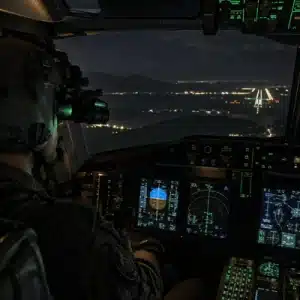
Night vision systems continue to improve, but many changes are happening inside existing goggle platforms.
Current MX-10160 aviation tubes are available in green and white phosphor versions. That means an ANVIS 6 or ANVIS 9 can vary a lot depending on the tubes installed. The same tube line is specified at a minimum of 64 or 72 line pairs per millimeter, depending on the figure of merit called for, so phosphor color is only one of the variables that change what a crew sees.
Panoramic systems are also moving beyond military programs. In August 2026, Aviation Specialties Unlimited announced FAA TSO-C164c approval for its Lightweight E3 PANO system.
That is an important step, but it does not create blanket approval for every aircraft. The installation and aircraft setup still need proper review.
Lighting remains another concern. FAA guidance notes that some LED lights may not appear clearly through NVGs. Pilots still need unaided scanning during low-altitude flight and landing-area checks.
What is ANVIS 10?
ANVIS 10 is a panoramic night vision system made for military aviation. It uses four tubes instead of the usual two. This gives the pilot about a 95-degree field of view. Standard binocular aviation goggles provide about 40 degrees.
What is the difference between ANVIS 6 and ANVIS 9?
Both are binocular Gen 3 aviation goggles. Both are used in fixed-wing and rotary-wing aircraft. The bigger differences often come from the tubes, optics, age, and setup. That is why the exact goggle matters more than the model name alone.
Is ANVIS 10 FAA-approved?
Not automatically. FAA approval depends on the equipment, aircraft installation, and NVIS lighting setup. A TSO does not approve a goggle for every aircraft. The full configuration must be checked before use.
How does ANVIS 10 vs GPNVG 18 compare?
Both use four tubes and provide a wide field of view. ANVIS 10 was made for aviation, while GPNVG-18 was made for ground use. The GPNVG-18 provides about a 97-degree view. Their similar layout does not make them interchangeable.
How often do pilots need NVG currency?
FAA rules require pilots to keep recent NVG experience. Passenger-carrying flights generally require the listed tasks within the previous two calendar months. Other PIC rules may allow up to four calendar months. A proficiency check may be required after that.
Can NVGs see every runway or obstruction light?
No. Some LED lights may fall outside the range that NVGs can detect. FAA guidance warns crews about this problem. Pilots should still use unaided vision during low-level flight and landing-area checks.
ANVIS 6, ANVIS 9, and ANVIS 10 are not simply older and newer versions of the same goggle. Each system fits a different set of needs. Start with aircraft approval, then compare the mission, tubes, comfort, and support. Contact Night Flight Concepts to discuss the right Gen 3 aviation NVG setup for your aircraft and flight operation.