(888) 632-8764

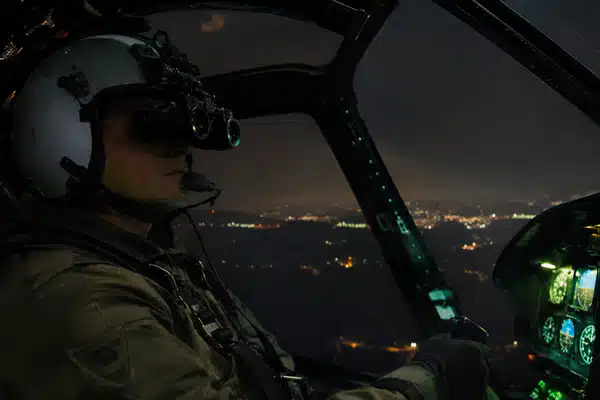
Flying with night vision goggles (NVGs) comes with its own set of FAA rules. Under 14 CFR 61.1(b), an NVG operation is the part of a flight, between 1 hour after sunset and 1 hour before sunrise, in which the pilot keeps visual reference to the surface using NVGs in an aircraft approved for that use. The FAA added NVG-specific pilot training and recent experience requirements to Part 61 through a final rule that took effect on October 20, 2009.
Under 14 CFR 61.57, pilots must complete certain flight tasks before carrying passengers during NVG operations. Those tasks must fall within the two calendar months before the flight month. Pilots flying without passengers have a four-month window. Each task has to be performed and logged as the sole manipulator of the controls on a flight during an NVG operation.
These requirements are different from the usual night flying rules. They also build on two other sets of rules: the initial NVG ground and flight training and endorsements required by §61.31(k), and the NVG equipment list in 14 CFR 91.205(h). This guide explains what each rule requires, how to log NVG time, what happens when currency lapses, who can conduct an NVG proficiency check, and how the FAA’s 2026 radio altimeter rule affects NVG aircraft.
Table of Contents
What Is NVG Currency Under 61.57?
NVG currency means meeting the FAA’s recent flight experience rules for flying with night vision goggles. Section 61.57(f), titled “Night vision goggle operating experience,” lists the required tasks. Section 61.57(g) offers an NVG proficiency check as an alternative way to qualify.
The time limit depends on who’s aboard. Section 61.57(f) gives pilots two different windows for completing their required tasks.
| Type of NVG Operation | Required Currency Window |
| PIC with passengers | 2 calendar months before the flight month |
| PIC without passengers | 4 calendar months before the flight month |
The windows count back in calendar months from the month of the flight, not from the exact date. For example, a pilot who completes and logs every required task on March 5 meets the two-calendar-month passenger window for flights through May 31 and the four-calendar-month window for flights through July 31.
Standard night currency under §61.57(b) applies when carrying passengers between 1 hour after sunset and 1 hour before sunrise. It requires at least three takeoffs and three landings to a full stop during that period within the preceding 90 days, as the sole manipulator of the flight controls, in the same category, class, and type of aircraft (if a class or type rating is required), subject to applicable exceptions.
Basic night currency does not replace NVG currency. A pilot may meet the usual night landing rule but still lack the recent NVG experience needed to carry passengers.
NVG Currency Requirements: Tasks You Must Log
The FAA requires pilots to complete specific tasks as the sole manipulator of the flight controls on a flight during an NVG operation.
Under §61.57(f), the required tasks include:
| Required Task | Airplane | Helicopter / Powered-Lift |
| NVG takeoffs and landings | 3 each* | 3 each* |
| Hovering tasks | Not applicable | 3* |
| Area departure and arrival tasks | 3 | 3 |
| Aided-to-unaided-to-aided transitions | 3 | 3 |
| NVG operations | 3 | 6 |
Takeoff and landing tasks apply when NVGs are used during those phases. Hovering tasks apply when pilots use NVGs while hovering.
A qualifying takeoff and landing includes climbout, cruise, descent, and approach phases.
Pilots must also practice switching from goggle-assisted vision to unaided vision and back again.
These NVG currency requirements cover situations pilots face during actual night missions. Switching between aided and unaided vision is especially important when light conditions change.
How to Log NVG Time Correctly
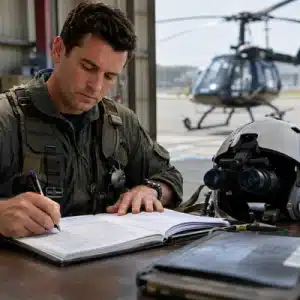
Your logbook needs to show more than the hours spent wearing goggles. The FAA has rules about which NVG time counts and what details to record.
Under 14 CFR 61.51(k), pilots may log NVG time when goggles serve as their primary visual reference of the surface and they are operating either an aircraft during an NVG operation or a full flight simulator or flight training device with its lighting adjusted to represent the period from 1 hour after sunset to 1 hour before sunrise.
Authorized instructors may also log NVG time when they conduct NVG training under the same conditions. To count logged NVG time toward the recent experience requirements of §61.57(f), the entry must include the information required by §61.51(b).
Required logbook details under §61.51(b) include:
- Date and total flight or lesson time
- Departure and arrival locations
- Aircraft or training device identification
- Type of pilot experience or training
- Flight conditions, including NVG use
Record the completed NVG tasks clearly so your recent experience can be verified.
Can Simulators Count Toward NVG Currency?
Section 61.51(k) permits qualifying NVG time to be logged in flight simulators and flight training devices under specified lighting conditions.
However, logging simulator time does not automatically satisfy §61.57(f)’s flight-task requirements.
Section 61.57(g) separately permits NVG proficiency checks in suitable full flight simulators or flight training devices.
What Happens When NVG Currency Expires?
Losing passenger-carrying currency does not always mean losing every NVG flying privilege.
If your required tasks fall outside the two-month window, you cannot act as PIC with passengers under §61.57(f)(1).
However, you may still qualify for PIC operations without passengers under the four-month rule. During that time, you can fly the required tasks without passengers to restore passenger-carrying currency.
If you no longer meet either currency window, an NVG proficiency check under §61.57(g) provides a way to regain the required privilege.
Plan recurrent training before your currency lapses to avoid gaps in flight readiness.
NVG Proficiency Check Under 61.57(g)
An NVG proficiency check evaluates whether a pilot can perform required night vision flight tasks.
Unlike routine currency tasks, the check follows 14 CFR 61.31(k) and covers:
- NVG and aircraft lighting checks before flight
- Correct preparation and use of goggles
- Takeoff, climb, cruise, descent, and landing techniques
- Normal, abnormal, and emergency procedures
Pilots can take the check in an aircraft of the right category. A suitable flight simulator or training device is another option.
NVG Proficiency Check
The FAA allows several people to conduct these checks. They include qualified examiners, authorized instructors, certain company check pilots, and other eligible NVG pilots.
Initial NVG qualification and recent flight experience are separate requirements. Pilots must also hold the required training endorsements or meet an applicable exception.
Why 5G and Radio Altimeters Matter in 2026
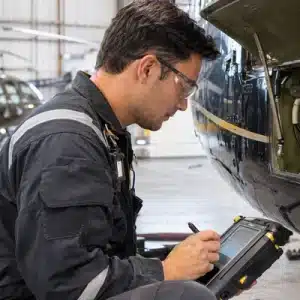
NVG safety depends on more than pilot currency.
Under 14 CFR 91.205(h), covered NVG aircraft must have approved equipment, including a working radar altimeter. The full list of instruments and equipment that must be installed, functioning normally, and approved for use by the FAA is:
- All instruments and equipment required for day and night VFR under §91.205(b) and (c)
- Night vision goggles
- Interior and exterior aircraft lighting system required for NVG operations
- Two-way radio communications system
- Gyroscopic pitch and bank indicator (artificial horizon)
- Generator or alternator of adequate capacity for the required instruments and equipment
- Radar altimeter
Some 5G C-band signals can interfere with radio altimeter readings. Radio altimeters operate in the 4.2 to 4.4 GHz band, and lower C-band 5G service (3.7 to 3.98 GHz) began operating near U.S. airports in January 2022.
For helicopters, the FAA issued Airworthiness Directive (AD) 2023-11-07, effective June 22, 2023. It applies to helicopters equipped with a radio altimeter. Unless the installed radio altimeter meets the AD’s interference tolerances, the rotorcraft flight manual must include limitations prohibiting certain operations that rely on radio altimeter data, such as engaging hover or search-and-rescue autopilot modes.
The FAA addressed this concern with a final rule published in July 2026. It sets new standards for radio altimeters so nearby wireless signals won’t disrupt their readings.
The rule took effect in September 2026. Depending on the type of operation, aircraft must meet the new standards by December 2030 or October 2034.
Before an NVG mission, pilots should check the aircraft’s approved equipment and any limits that apply. Current NOTAMs should also be part of that review.
For EMS, law enforcement, and search-and-rescue crews, reliable equipment and current NVG skills are both essential.
What is 14 CFR 61.57(f)?
Section 61.57(f) explains what pilots must do to keep their NVG flying privileges current. The tasks cover takeoffs, landings, departures, arrivals, and changes between aided and unaided vision. Helicopter and powered-lift pilots have additional tasks when applicable.
How is NVG currency different from standard night currency?
Three full-stop night landings may satisfy the usual night currency rule, but they aren’t enough for NVG flying. The FAA expects pilots to practice other tasks while using their goggles. Both sets of rules matter when preparing to carry passengers at night.
Can I regain NVG currency without carrying passengers?
Yes, provided your recent tasks still fall within the four-calendar-month window in §61.57(f)(2). You may fly without passengers while completing the tasks needed for passenger-carrying currency. If neither currency window is met, you need the proficiency check described in §61.57(g) before acting as PIC using NVGs.
Can I use a simulator for an NVG proficiency check?
Yes, but the training device must meet the requirements in §61.57(g). It must represent the aircraft category for which you’re seeking NVG privileges. Logging simulator time alone doesn’t replace the check.
Who can conduct an NVG proficiency check?
Section 61.57(g) lists several people authorized to conduct these checks. They include qualified examiners, authorized instructors, and certain company check pilots. Some qualified NVG PICs and FAA-approved individuals may also conduct them.
How many NVG operations must helicopter pilots complete?
Helicopter pilots must complete six NVG operations within the applicable currency window. They must also complete the other required tasks, including hovering when applicable. The FAA lists these requirements in §61.57(f).
Is logging NVG time the same as logging PIC time?
No. Wearing NVGs and acting as PIC are not the same thing for logbook purposes. Section 61.51 has separate rules for each, while §61.57(f) requires pilots to be the sole manipulator of the controls during currency tasks.
Staying current under 61.57 helps pilots prepare for demanding night missions. At Night Flight Concepts, we offer FAA-approved aviation NVG training, including initial and recurrent courses in Waco, Texas, and training at approved locations. Contact us today to book your NVG training or request a course quote.