(888) 632-8764

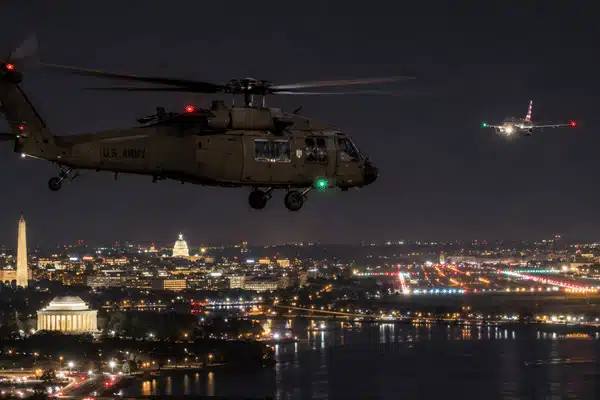
On January 29, 2025, the DCA crash claimed 67 lives when a U.S. Army Black Hawk struck American Airlines Flight 5342 near Reagan National Airport. It was the deadliest U.S. aviation accident since November 2001. The helicopter crew was flying with night vision goggles (NVGs). Can pilots see other aircraft with night vision goggles? Yes, although spotting aircraft lights doesn’t always mean pilots know what they’re looking at. In January 2026, the NTSB adopted 74 findings and 50 safety recommendations that raised serious questions about airspace design and how crews spot traffic at night.
Table of Contents
What Happened in the DCA Crash
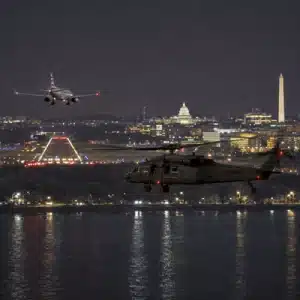
The collision happened at 8:48 p.m. near Runway 33. The two aircraft collided over the Potomac River about half a mile southeast of the airport. The Black Hawk, known as PAT25, hit a CRJ700 preparing to land. None of the 64 people on the plane or three soldiers aboard the helicopter survived.
PAT25 was on a training flight for the pilot’s annual standardization evaluation with NVGs. Flight 5342, operated by PSA Airlines, was arriving from Wichita, Kansas, and had agreed to a controller’s request to switch to Runway 33.
The NTSB identified several problems that contributed to the Black Hawk crash:
- Unsafe flight routes: Helicopters were allowed to fly dangerously close to planes approaching the airport. The NTSB named the FAA’s placement of Route 4 near the Runway 33 approach path as part of the probable cause.
- Heavy reliance on visual separation: Pilots were often expected to spot nearby aircraft and maintain safe distances themselves. The Board cited the air traffic system’s overreliance on visual separation to keep traffic flowing efficiently.
- Air traffic control issues: Controllers faced heavy workloads, while key warnings and radio calls failed to prevent the collision. The tower had combined its helicopter and local control positions, and about 90 seconds before the collision, the controller was handling 12 aircraft: seven airplanes and five helicopters.
- Poor safety oversight: The FAA had not done enough to address known risks around the airport. Investigators found the agency did not act on concerns raised by local controllers and helicopter operators.
Investigators did not name defective night vision goggles as a cause. The probable cause the Board adopted does not cite any malfunction of the goggles.
Can Pilots See Other Aircraft Through NVGs?
Yes, NVGs help pilots spot aircraft lights at night. The harder part is knowing exactly what those lights belong to.
The Army’s AN/AVS-6 goggles offered a 40-degree field of view. White-phosphor versions provided roughly 20/25 visual acuity, compared with 20/40 for green-phosphor models. PAT25 carried four sets of goggles, two green phosphor and two white phosphor. Investigators could not determine which crewmember wore which type.
NTSB investigators tested white-phosphor ANVIS 9 goggles near DCA. Aircraft lights were visible from more than 16 miles away. The NTSB’s board presentation described clear detection of aircraft above the horizon at more than 14 nautical miles, or roughly 16 statute miles. Aircraft at or below the horizon were harder to detect because city lighting got in the way.
An Army instructor also explained that brighter lights could make a distant aircraft seem closer than it was.
Why NVGs Struggle Near Cities
Picture flying over Washington at night. Buildings, roads, and cars create thousands of lights below. Through NVGs, picking out one aircraft light from that background becomes difficult.
| NVG Limitation | What Pilots Experience |
| Narrow field of view | Crews must move their heads to scan more of the sky |
| Aircraft appear as lights | It’s difficult to tell which aircraft they’re seeing |
| Bright ground lighting | Aircraft lights can get lost among city lights |
| Limited distance cues | A brighter light doesn’t always mean a closer aircraft |
This was a concern during the DCA crash. The NTSB found that several other airplanes were in the instructor pilot’s view, and any of them could have been mistaken for Flight 5342.
He told air traffic control that he could see the traffic. However, the crew had not confirmed that they were watching the approaching CRJ700. The controller’s question did not include a clock position or distance to help them look in the right place.
Expectation likely played a part. Only 5% to 7% of northbound arrivals landed on Runway 33, and the NTSB said the instructor pilot likely concluded the jet was heading for Runway 1. Static made the controller’s word “circling” inaudible, so the crew missed that the jet was circling to a different runway.
See and Avoid Aviation: Where It Broke Down
Under the FAA’s see and avoid aviation principle, pilots must watch for other aircraft and avoid collisions.
There’s also pilot-applied visual separation. This allows a pilot to maintain spacing from another aircraft after identifying it and receiving clearance from air traffic control.
Both rely on pilots seeing the right traffic.
Near DCA, controllers used visual separation frequently despite the mix of helicopters and passenger jets. Part of a radio instruction to pass behind the CRJ was also blocked by another transmission. A helicopter crewmember keyed the microphone for 0.8 seconds as the controller spoke, cutting out the words that told PAT25 to pass behind the jet. The controller didn’t know the call had been blocked. The instructor pilot then requested visual separation, which the controller approved.
The helicopter carried tablets that could display nearby traffic. During an NTSB simulation, those devices could have produced a warning 48 seconds before the collision. However, the crew likely wasn’t watching the screens, and audio alerts weren’t connected to their helmets.
The crash exposed the danger of relying on visual checks without enough support from other safety systems.
DCA Crash | January 2025
Where See-and-Avoid Broke Down
Traffic Not Confirmed
Visual separation depends on spotting the correct aircraft. The crew accepted separation without confirming the jet.
ATC Call Blocked
A 0.8-second radio overlap masked the instruction to pass behind the CRJ. The controller did not know.
Warning Not Heard
In an NTSB simulation, a tablet alert was possible 48 seconds before impact. Helmet audio was not connected.
What Changed After the DCA Crash
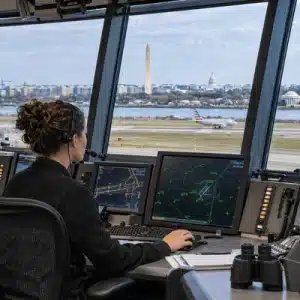
The FAA began tightening helicopter rules around Reagan National Airport in 2025. In March 2025, after the NTSB issued two urgent recommendations, the FAA permanently closed part of Route 4 and ended visual separation between helicopters and airplanes near the airport. More lasting restrictions followed in January 2026.
Here are the main changes:
- Route 4 closure: The helicopter route between Hains Point and the Wilson Bridge remains closed.
- New separation rules: Pilots can no longer use visual separation between helicopters and airplanes within five nautical miles of DCA.
- ADS-B Out requirements: Most aircraft flying through this area must send out their position using ADS-B. The FAA still allows a few exceptions.
- Restricted helicopter access: Only approved essential flights can enter certain areas near the airport.
The changes didn’t stop there.
In March 2026, the FAA extended restrictions to more busy airport areas nationwide. Controllers must use radar separation instead of relying on pilots to maintain visual spacing where helicopter and airplane flight paths cross in affected airspace.
The NTSB also called for better cockpit traffic displays, wider use of ADS-B In, and improved collision-avoidance systems.
Make night flight training part of your crew’s safety plan. Night Flight Concepts provides FAA-approved initial, recurrent, and instructor NVG training. Book your aviation NVG training today.
What caused the DCA crash?
The NTSB found serious problems with flight routes, air traffic control, and the way aircraft were separated. Helicopters and passenger planes were operating too close together without enough safeguards. Investigators also found that known safety risks had not been properly addressed.
Can pilots see other aircraft with night vision goggles?
They can, although a plane may look like nothing more than a small light in the distance. That makes it hard to judge how far away it is or even tell which aircraft they’re looking at. Pilots need to be sure they’ve spotted the correct traffic before agreeing to maintain visual separation.
Were the NVGs defective in the Black Hawk crash?
The NTSB did not find that defective goggles caused the collision. Investigators focused on the crew’s traffic awareness and problems with the airport’s flight procedures. NVGs have viewing limits even when functioning as intended.
What is see and avoid aviation?
See and avoid means pilots must keep watch for nearby aircraft and take action to avoid them. This responsibility applies even when controllers provide traffic information. Pilots must also follow any ATC separation rules that apply to their flight.
What is the difference between ADS-B Out and ADS-B In?
Think of ADS-B Out as an aircraft telling other systems where it is. ADS-B In works the other way around, receiving traffic data that pilots can see on a cockpit screen. Some setups can warn crews about nearby aircraft, but that depends on the equipment they’re using.
What changed for helicopter pilots after the crash?
Helicopters can no longer use the closed section of Route 4 near Reagan National Airport. The FAA also stopped allowing certain visual separation procedures around DCA. In March 2026, similar restrictions reached more busy airport areas across the country.
How can NVG crews reduce collision risk?
A bright light ahead doesn’t tell pilots everything they need to know. Crews should check that they’ve found the right aircraft, speak up when something looks wrong, and make good use of their traffic displays. Regular NVG practice also gives pilots a chance to work through these situations before facing them in the air.
The DCA crash showed how a crew can spot aircraft lights and still miss a serious threat. Goggles alone can’t keep aircraft safely apart. Pilots also depend on good radio calls, dependable traffic information, sensible flight routes, and training that prepares them for difficult nights.